




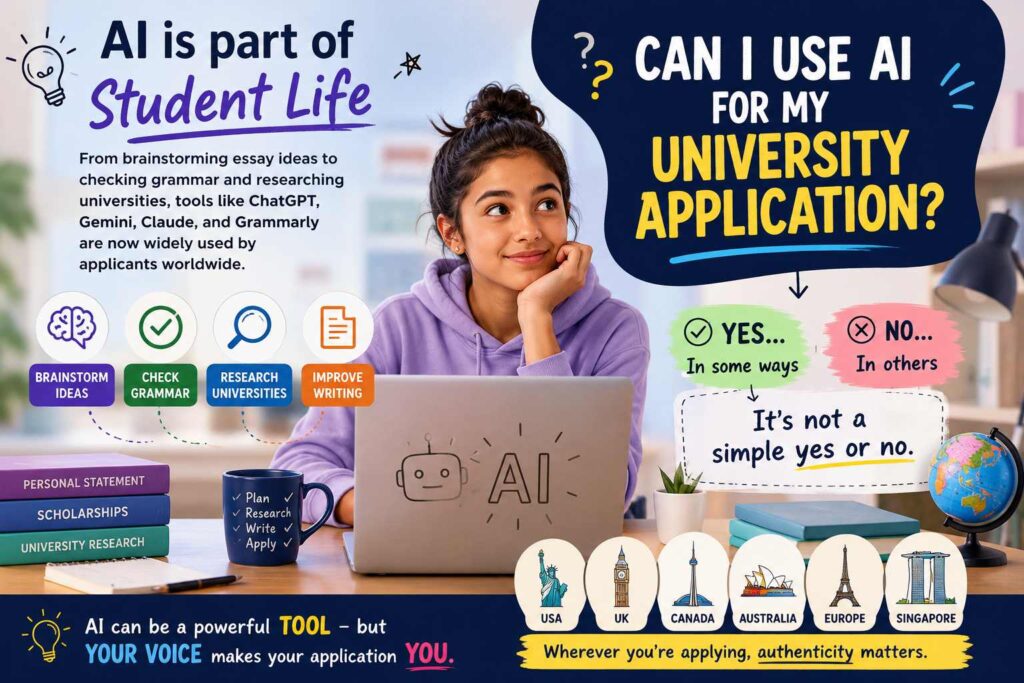
The college application season has undergone a permanent shift. Generative AI tools like ChatGPT, Claude, and Gemini have evolved from experimental text boxes into ubiquitous digital consultants. For high school seniors facing a mountain of personal statements, supplemental essays, and complex institutional portals, the temptation to delegate the heavy lifting to an AI is immense.
But as admissions committees across the globe adapt, the lines defining ethical boundaries have hardened. Today, a heavily “Over-AI-ed” essay doesn’t just sound bland—it can get your application disqualified.
Navigating this terrain requires understanding the global landscape of AI ethics in admissions. Here is the definitive breakdown of when it is completely alright to leverage AI, when you must step away from the keyboard, and how expectations differ from the US to Singapore.
The Green Light: When AI is a Valid Assistant
Admissions officers generally agree that AI can democratize the college application process, acting as a free counselor for students who might not have access to expensive private consultants. Using AI for the following non-content-generation tasks is highly ethical and widely accepted:
- Curating Your College List: Instead of spending dozens of hours browsing scattered forums, you can use AI to narrow your choices. Asking a tool to “Find mid-sized universities in Canada with strong undergraduate biomedical research and a vibrant campus culture” is an excellent, time-saving use of technology.
- Brainstorming and Outlining: Struggling with writer’s block on a prompt? You can use AI to spark ideas. It is completely acceptable to feed an AI prompt into a tool and ask for five unique conceptual angles based on your raw, bulleted life experiences.
- Line-Level Polishing and Proofreading: Think of AI as a hyper-advanced spellchecker. Using it to catch clunky phrasing, fix grammatical errors, or check if your essay flows logically falls well within the boundaries of acceptable use at the vast majority of institutions.
The Red Light: When AI Crosses the Line
The core purpose of a college application—especially the essay—is to allow real human admissions officers to understand your unique voice, values, and lived experiences. The moment AI replaces your authentic humanity, you have crossed an ethical line.
- Drafting and Writing the Essay: Passing off AI-generated paragraphs as your own writing is plagiarism. Even if an AI detector doesn’t catch it, human readers are highly trained to spot the “corporate,” overly polished, and oddly detached tone typical of LLMs.
- Fabricating Experiences: Using AI to embellish extracurricular activities, hallucinate leadership roles, or generate emotional stories about hardships you never experienced is flat-out fraud.
- Masking Your True Persona: If you feed your genuine draft into an AI and ask it to “rewrite this to sound like an Ivy League student,” you erase your personality. Admissions teams want to admit you, not a generic mathematical average of what an algorithm thinks a student should sound like.
The Global Rules: How Regions Differ
AI policies are far from universal. Different regions, and even specific elite universities within them, have established wildly divergent rulebooks.
1. The United States: A Fragmented Spectrum
The US features the most fragmented landscape. A 2026 data analysis of American universities showed that while roughly 70% of schools still lack a formal, codified AI policy, the top-tier institutions have taken clear stances:
- The Permissive/Line-Level Approach: Schools like Cornell University allow AI for minor grammar checks and research but strictly ban it for content generation. Duke University permits general AI use, though its law and nursing schools ban it.
- The Guardrails Model: CalTech takes a slightly different approach, and lists what it considers unethical and ethical uses of AI for its admissions essays.
- The Total Ban: Elite institutions like Brown University and Harvard require students to attest that no generative AI was used to write their materials, treating unauthorized use as a direct violation of their strict honor codes. Yale University, for instance, says “submitting ‘the substantive content or output of an artificial intelligence platform, technology, or algorithm’ constitutes application fraud” and may result in “admission revocation or expulsion.”
2. The United Kingdom: Focus on Authenticity
The UK’s centralized application system (UCAS) and top-tier institutions like Oxford, Cambridge, and Imperial College London focus heavily on originality and voice.
- Imperial College London explicitly warns candidates against using AI-generated scripts during video interviews, noting that reading artificial phrasing is immediately visible to human reviewers.
- Cambridge and Oxford both maintain that while AI can support personal study, but submitting unacknowledged AI text in any part of an assessment or application constitutes academic misconduct.
- The consensus in the UK is clear: treat AI like a friend reading your essay—helpful for a quick edit, but never the author.
3. Canada and Australia: Hardening Against Academic Misconduct
Both Canada and Australia tie admissions ethics directly to their university-wide academic integrity frameworks.
- In Australia, elite institutions like the University of Melbourne categorize the unacknowledged use of generative AI in application documents as a severe breach of academic honesty, equivalent to traditional plagiarism.
- Canadian universities lean heavily on holistic reviews. While they allow tools like Grammarly for baseline editing, they utilize advanced screening protocols to flag applications that lack a natural, intimate student voice.
4. Singapore and Europe: The Holistic Barrier
- Singapore: Highly selective institutions like the National University of Singapore (NUS) and Nanyang Technological University (NTU) value strict academic rigor. Their application pipelines are designed to evaluate genuine individual capability. Using AI to generate personal statements bypasses the self-reflection they actively test for.
- Europe: Across mainland Europe (such as institutions in Germany, France, or the Netherlands), admissions are often highly structured, relying heavily on hard data (GPAs, exam scores) alongside motivation letters. Where motivation letters are weighed, European institutions expect a high level of transparency. The general European higher education framework heavily penalizes any tool usage that introduces bias or misrepresents a student’s true language and writing proficiency.
The Ultimate Rule of Thumb
If you are unsure whether your use of AI is ethical, ask yourself: “Am I using this tool to help me express my thoughts more clearly, or am I using it to think for me?”
If AI is doing the thinking, the reflecting, or the writing, delete the draft and start over. Your application shouldn’t sound flawless; it should sound like you. Ultimately, authenticity is the only metric an algorithm can never replicate.
Final Thoughts
Think of AI as a tutor, editor, or brainstorming partner—not as your ghostwriter.
Admissions officers want to understand your story. Make sure it remains your story.